显示标签为“Iran”的博文。显示所有博文

2012年9月13日星期四

LIVE: VIOLENT PROTESTS IN YEMEN, EGYPT, IRAN, AFGHANISTAN


09.01 EDT:

SYRIAN OPPOSITION'S STATEMENT ON PROTESTS

The opposition Syrian National Council has issued a statement condemning the use of violence to protest about the film:
With deep distress the Syrian National Council watched the insults by a group of American bigots to the messenger of Islam and peace Muhammad peace be upon him. The Council, however, was shocked by the reaction to these insults in the form of murder, burning, and destruction.
We condemn the repeated insults to the noble prophet peace be upon him and are outraged to see them tied to the anniversary of the September 11 attacks by suggesting that there is a connection between the events and the tolerant message of Islam.
As we condemn the insults and consider them an assault on the feelings and beliefs of nearly one fourth of the population of the globe we stress the right of everyone who has been offended to express peacefully their rejection and condemnation of those who perpetrated them. However, the reaction by murder, burning, and destruction is rejected and unequivocally condemned.
The Syrian National Council condemns the killing of the US ambassador and the employees of the US embassy in Libya. This act is rejected and violates Islamic Shari'ah and all conventions of international relations that prohibit any assault on envoys and ambassadors and prohibits holding them responsible for actions committed by their compatriots.
08:54 EDT

SUMMARY

Here's a summary of events so far today

YEMEN

• Hundreds demonstrators stormed the US embassy in the capital Sana'a in protest at an anti-Islamic film following similar protests in Benghazi and Cairo. Security sources said 15 people were injured after police used teargas and gunfire to disperse the crowd. Windows to the embassy building were smashed, while cars and US flags were burned.
• Yemen's Yemen's president Abd Rabbo Mansour Hadi apologised for the attack. He blamed those responsible as "demagogic groups". The Yemeni embassy in Washington also condemned the attack.

EGYPT

• State media says 29 people were injured and 12 people were arrests after a second night of protests against the film turned violent. Riot police repeatedly used teargas to disperse protesters near the US embassy building.
• President Mohamed Morsi toughened his stance against the protests by condemning the attack on Libya that killed the American ambassador and vowing to protect foreign embassies in Cairo. Yesterday Morsi was slow to respond to the attack and then in his first remarks on the attacks urged the film makers to be sued. But speaking during a visit to the European Union in Brussels, he condemned "in the clearest terms" the attack in Benghazi.
• President Barack Obama has called on Morsi and his Libyan counterpart to continue working with the United States to ensure the safety of diplomatic personnel. Obama told Morsi that while "he rejects efforts to denigrate Islam ... there is never any justification for violence against innocents."

LIBYA

• Barack Obama has vowed to hunt down the killers of US ambassador Chris Stevens and three other Americans during an assault on its mission in Benghazi as suspicion grew that the diplomat was the victim of an organised attack by an Islamist group. "Make no mistake: justice will be done," Obama said at the White House. The FBI is being dispatched to Libya to help with the hunt, as well as 50 marines to reinforce the Tripoli embassy. Two US warships were reportedly heading towards the Libyan coast on Wednesday night. US surveillance drones are being redeployed to search for suspects among alleged jihadist camps in eastern Libya.

SYRIA

• Syrian rebels and a pro-government group clashed near a Shia shrine on the outskirts of Damascus on Thursday, activists said, killing at least three people. The continuing violence came as new international envoy Lakhdar Brahimi arrived in Damascus for talks with senior members of the Assad regime.
This article originally appeared on guardian.co.uk


2012年8月29日星期三

The Real War In Syria Is Between Saudi Arabia And Iran


syria


Saudi Arabia has gone on the offensive against Iran to protect its interests.  Their involvement in Syria is the first battle in what is going to be a long bloody conflict that will know no frontiers or limits.

Ongoing disorders in the island kingdom of Bahrain since February of 2011 have set off alarm bells in Riyadh.  The Saudis are convinced that Iran is directing the protests and fear that the problems will spill over the twenty-five kilometer long COSWAY into  oil rich Al-Qatif, where the bulk of the two million Shia in the kingdom are concentrated.  So far, the Saudis have not had to deal with demonstrations a serious as those in Bahrain, but success in the island kingdom could encourage the protestors to become more violent.

Protecting the oil is the first concern of the government.  Oil is the sole source of the national wealth and it is managed by the state owned Saudi Aramco Corporation.  The monopoly of political power by the members of the Saud family means that all of the wealth of the kingdom is their personal property.  Saudi Arabia is a company country with the twenty-eight million citizens the responsibility of the Saud Family rulers.

The customary manner of dealing with a problem by the patriarchal regime is to bury it in money.  King Abdullah announced at the height of the Arab Spring that he was increasing the national budget by 130 billion dollars to be spent over the coming five years.  Government salaries and the minimum wage were raised.  New housing and other benefits are to be provided.  At the same time, he plans to expand the security forces by sixty thousand men.

While the Saudi king seeks to sooth the unrest among the general population by adding more government benefits, he will not grant any concessions to the eight percent of the population that is Shia. He takes seriously the warning by King Abdullah of Jordan back in 2004 of the danger of a Shia Crescent that would extend from the coast of Lebanon to Afghanistan.  Hezbollah in Lebanon, Assad in Syria, and the Shia controlled government of Iraq form the links in the chain.

When the Arab Spring reached Syria, the leaders in Riyadh were given the weapon to break the chain.  Appeals from tribal leaders under attack in Syria to kinsmen in the Gulf States for assistance could not be ignored.  The various blinks between the Gulf States in several Syrian tribes means that Saudi Arabia and its close ally Qatar have connections that include at least three million people out of the Syrian populations of twenty-three million.  To show how deep the bonds go, the leader of the Nijris Tribe in Syria is married to a woman from the Saud Family.

It is no wonder that Saudi Foreign Minister Prince Saud al-Faisal said in February that arming the Syrian rebels was an “excellent idea."  He was supported by Qatari Prime Minister Hamad bin Jassim al-Thani who said, "We should do whatever necessary to help [the Syrian opposition], including giving them weapons to defend themselves."  The intervention has the nature of a family and tribal issue that the prominent Saudi cleric Aidh al-Qarni has turned into a Sunni-Shia War by promoting Assad’s death.

The Saudis and their Qatar and United Arab Emirate allies have pledged one hundred million dollars to pay wages to the fighters.  Many of the officers of the Free Syrian Army are from tribes connected to the Gulf.  In effect, the payment of wages is paying members of associated tribes.

Here, the United States is not a welcomed partner, except as a supplier of arms.  Saudi Arabia sees the role of the United States limited to being a wall of steel to protect the oil wealth of the Kingdom and the Gulf States from Iranian aggression. In February of 1945, President Roosevelt at a meeting in Egypt with Abdel Aziz bin Saud, the founder of modern Saudi Arabia, pledged to defend the kingdom in exchange for a steady flow of oil.

Since those long ago days when the U.S. was establishing Pax Americana, the Saudis have lost their trust in the wisdom or the reliability of American policy makers.  The Saudis urged the U.S. not to invade Iraq in 2003 only to have them ignore Saudi interests in maintaining an Iraqi buffer zone against Iran.  The Saudis had asked the U.S. not to leave a Shia dominated government in Baghdad that would threaten the Northern frontier of the Kingdom, only to have the last American soldiers depart in December 2011.  With revolution sweeping across the Middle East, Washington abandoned President Mubarak of Egypt, Saudi Arabia’s favorite non royal leader in the region.

Worried by the possibility of Iranian sponsored insurrections among Shia in the Gulf States, the Saudis are asserting their power in the region while they have the advantage.  For thirty years, they have been engaged in a proxy war with the Islamic Republic of Iran.  Syria is to be the next battlefield, but here, there is a critical difference from what were minor skirmishes in Lebanon, Yemen, and elsewhere.  The Saudis with the aid of Qatar, and the UAE is striking at the core interests of Tehran; and they have through their tribal networks the advantage over an isolated Islamic Republic.

Tribal and kinship relations are being augmented by the infusion of the Salafi vision of Islam that is growing in the Gulf States.  Money from the Gulf States has gone into the development of religious centers to spread the fundamentalist belief.  A critical part of the ideology is to be anti-Shia.

Salafism in Saudi Arabia is promulgated by the Wahhabi School of Islam.  The Wahhabi movement began in the eighteenth century and promoted a return to the fundamentalism of the early followers of the Faith.

The Sauds incorporated the religious movement into their leadership of the tribes.  When the modern state of Saudi Arabia was formed, they were granted control of the educational system and much else in the society in exchange for the endorsement of the authoritarian rule. 

When the Kingdom used its growing wealth in the 1970s to extend its interests far from the traditional territory in the battle against the atheistic Soviet Union, the Wahhabi clergy became missionaries in advancing their ideology through religious institutions to oppose the Soviets.  More than two hundred thousand jihadists were sent into Afghanistan to fight the Soviet forces and succeeded in driving them out.

There is no longer a Soviet Union to confront.  Today, the enemy is the Islamic Republic of Iran with what is described by the Wahhabis as a heretical form of Islam and its involvement in the Shia communities across the region.  For thirteen centuries, the Shia have been kept under control.  With the hand of Iran in the form of the Qud Force reaching into restless communities that number as many as one hundred and six million people in what is the heart of the Middle East, the Saudis see a desperate need to crush the foe before it has the means to pull down the privileged position of the Saud Family and the families of the other Gulf State rulers.

The war begins in Syria where we can expect that a successor government to Assad will be declared soon in the Saudi controlled tribal areas even before Assad is defeated.  The territory is likely to adopt the more fundamentalist principals of the Salafists as it serves as a stepping stone to Iran Itself.  It promises to be a bloody protracted war that will recognize no frontier and will know no limits by all of the participants.


2012年5月23日星期三

Here's Why Western Sanctions On Iran Are Not Working


Oil Well derrick
Iran's agreement with the IAEA for an investigation of its nuclear program has some hoping that US and EU sanctions are working.
The six nations starting talks today in Baghdad certainly hope so.

But in an interview with the Council on Foreign Relations, London Middle East Institute director Hassan Hakimian argues that they have not been particularly effective:
  • Iran has been sanctioned before, and was expecting these. It is better prepared than people realize. 
  • Oil is important to Iran, but it is not everything.  It is "large regional economy with a relatively diversified structure".
  • Other nations (North Korea, Cuba) have dealt with harsher sanctions for larger periods. 
  • Iran has options for its oil, it can enter barter arrangements, sell at a discount, or conduct transactions in other currencies, as it has in India. 
  • The sanctions have worsened problems in the Iranian economy, including inflation/high staple prices and unemployment. However, these problems primarily affect ordinary Iranians. The impact on the ruling elite is muted.
  • Iran's oil revenues have allowed it to build currency reserves of at least $80 billion. They aren't in danger of being unable to import essential goods in the near term.

Hopefully the talks will succeed. There have been promising signs, but Iran may be capable of surviving sanctions for some time to come. 

Read the full interview at cfr.org


2012年3月16日星期五

5 Signs That A War With Iran Is Close


iran mural
The clock is ticking closer to the midnight hour regarding a strike in Iran. Israel might do it alone, but will likely have the backing of the US.
Is a war imminent, or are these moves just meant to scare Iran? Here are 5 signs that have piled up very recently.
  1. SWIFT Cuts Iran Off: The international institution responsible for around 80% of the world’s financial transactions announced that it will cut off Iranian financial institutions from its system from Saturday. This unprecedented move is a big blow to Iran, and follows up on EU sanctions.
  2. Majority in Israeli cabinet for strike: Israeli newspaper Maariv (Hebrew link, quote in English) by Ben Caspit saying that 8 out of 14 Israeli cabinet members now support a strike on Iran’s nuclear facilities. The cabinet can give Prime Minister Netanyahu the green light for a strike, at the time he sees fit.
  3. Netanyahu preparing Israeli public: The Israeli Prime Minister continues the tough rhetoric against Iran also after coming back from his long visit in the US. Analysts see this as a preparation of the Israeli public for a war.
  4. Using Oil Reserves: There was a report, later denied, that the US and the UK decided on releasing oil from the emergency reserves in order to lower prices. This could be another preparation.
  5. “Last Chance” Warning: According to Russian sources, US Secretary of State Hillary Clinton asked the Russians to send a message to Iran that the upcoming talks 6 nation talks with Iran are the last chance before military action.
Needless to say, oil prices certainly play a role in the considerations of all sides. Iran is the world’s 5th largest producer of oil, and sits on the Straights of Hormuz, where 40% of the world’s shipments pass through.
All these moves could mount to a preparation for a US backed Israeli strike against Iran’s nuclear facilities. It could also just add to pressure against Iran, trying to force it to comply without really engaging in military action.
There are many other interests that push leaders to higher rhetoric, such as internal politics. Here are
Further reading:


2012年3月6日星期二

MARC FABER: War With Iran Is 'Almost Inevitable'


marc faber
Swiss money manager and long term bear Marc Faber, aka "Dr Doom", says political risk in the Middle East has increased significantly with war between Iran and Israel “almost inevitable”, and precious metals and equities investments offer some safety.

"Political risk was high six months ago and is higher now. I think sooner or later, the U.S. or Israel will strike Iran - it's almost inevitable," Faber, who publishes the widely read Gloom Boom and Doom Report, told Reuters on the sidelines of an investment conference.

Brent crude traded near $123 per barrel in volatile trade on Tuesday on fears of a disruption in Iranian supplies. Israeli Prime Minister Benjamin Netanyahu showed no signs of backing away from possible military action against Iran following a Monday meeting with U.S. President Barack Obama.

"Say war breaks out in the Middle East or anywhere else, (U.S. Federal Reserve chairman) Mr Bernanke will just print even more money -- they have no option...they haven't got the money to finance a war," said Faber.

"You have to be in precious metals and equities ... most wars and most social unrest haven't destroyed corporations - they usually survive," he said.

He said that Middle East markets had largely bottomed out, though regime changes from the Arab Spring revolutions were unlikely to be investor-friendly.

Faber said that in uncertain times, investors had to reconcile themselves to volatility.
"If you can't live with volatility, stay in bed," he said, pointing out that even cash [sic].
The 66 year-old, who has earned the moniker "Dr Doom", earlier told the conference that the likelihood of war in the Middle East was boosted by Western powers' imperatives of keeping China in check, given its dependence on Middle Eastern oil.

"The Americans and the western powers know very well they cannot contain China economically.... but one way to contain China is to switch on and switch off the oil tap from the Middle East," he said.
"I happen to think the Middle East will go up in flames," he said.


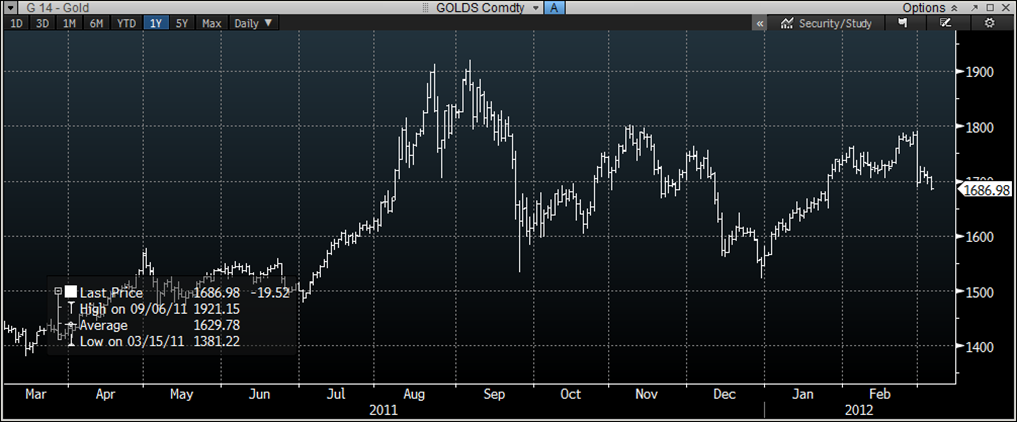
Gold’s London AM fix this morning was USD 1,685.60, EUR 1,282.24 and GBP 1,068.26 per ounce.
Yesterday's AM fix was  USD 1,698.00, EUR 1,286.17 and GBP 1,073.60 per ounce.

Gold fell $6.30 in New York yesterday and closed above the $1,700/oz level at $1,705.30/oz. Gold fell in Asia prior to further modest price falls in Europe which saw it fall below yesterday's inter day low of $1,694/oz. Gold is now trading at $1,686.40/oz.

Gold’s short term technicals are poor and a further correction to or below the 200-day moving average at $1,670/oz is possible. However, it is worth noting that gold’s weakness has coincided with recent dollar strength and gold has not fallen as much in euro, pound or other fiat currency terms.

The fundamentals of significant macroeconomic, systemic  and monetary risk will support the precious metals. As will the increasingly risky geopolitical situation - the risk of which is not priced into markets just yet.


Swiss money manager and long term bear Marc Faber, aka "Dr Doom", says political risk in the Middle East has increased significantly with war between Iran and Israel “almost inevitable”, and precious metals and equities investments offer some safety.

"Political risk was high six months ago and is higher now. I think sooner or later, the U.S. or Israel will strike Iran - it's almost inevitable," Faber, who publishes the widely read Gloom Boom and Doom Report, told Reuters on the sidelines of an investment conference.

Brent crude traded near $123 per barrel in volatile trade on Tuesday on fears of a disruption in Iranian supplies. Israeli Prime Minister Benjamin Netanyahu showed no signs of backing away from possible military action against Iran following a Monday meeting with U.S. President Barack Obama.

"Say war breaks out in the Middle East or anywhere else, (U.S. Federal Reserve chairman) Mr Bernanke will just print even more money -- they have no option...they haven't got the money to finance a war," said Faber.

"You have to be in precious metals and equities ... most wars and most social unrest haven't destroyed corporations - they usually survive," he said.

He said that Middle East markets had largely bottomed out, though regime changes from the Arab Spring revolutions were unlikely to be investor-friendly.
Faber said that in uncertain times, investors had to reconcile themselves to volatility.

"If you can't live with volatility, stay in bed," he said, pointing out that even cash [sic].

The 66 year-old, who has earned the moniker "Dr Doom", earlier told the conference that the likelihood of war in the Middle East was boosted by Western powers' imperatives of keeping China in check, given its dependence on Middle Eastern oil.

"The Americans and the western powers know very well they cannot contain China economically.... but one way to contain China is to switch on and switch off the oil tap from the Middle East," he said.

"I happen to think the Middle East will go up in flames," he said.


2012年3月1日星期四

Q&A: When And How Israel Will Attack Iran


A very big question mark hanging over the global table is what the hell is going to happen between Iran and Israel. I spoke with a fellow in Europe I know who has an informed opinion. There were no secrets discussed, but his thoughts on some of the variables including Syria, bunker bombs and timing were interesting.

Will Israel allow Iran to develop a nuke?
Not a chance in hell.

What is the “over - under on timing”?
Certainly less than two years.

Does Israel have the capacity to take out concrete hardened facilities in Iran?
Yes, but this is by no means an easy task.

Explain?
chart

It is not possible for the Israel Air force to attack without going over some other country’s border. The choices are Turkey (Iraq then Iran), Jordan (Saudi Arabia, Iraq then Iran), Syria (Iraq then Iran) or Saudi Arabia (Direct to Iran).


Which route will Israel choose?
It will go over Syria. There would be hell to pay if Israel went over Turkey or Jordan. If the Saudis “permitted” it, the Iranians would retaliate by assassinating Saudis all over the world. So it will be Syria. This is especially true as the country is in chaos today.

Will Syria attempt to shoot down Israeli aircraft flying over its territory?
Yes, it has surface-to-air capability and it also has MiG-23 and MiG-27 fighters. The Israelis will escort their bombers over Syria with their F16s. These fighters will wipe out anything that Syria puts up. The ground-based defenses are old, and no doubt poorly manned these days.

Is it a problem if Israeli attack bombers fly over Iraqi territory?
No one gives a shit about Iraq anymore.

What happens when the Israeli bombers get over Iranian air space?
This question has no answer. If it happens, this would be the most advertised air attack in history. The Iranians have sophisticated radar and surface to air capability they bought from China. It would be a mistake to assume that an attack can be made without losses.

How would the attack take place?
Israel will use its F15s. Each plane will be armed with a single laser-guided bunker buster bomb. It will use their F16s as escorts.
As of today, Israel “officially” has only thirty of these bunker bombs. It has a total of 100 F15 attack bombers, so it needs more bombs to fully utilize their strike capability. Look for a sign on this. If the U.S. agrees to supply more bombs, the timing is close.

What is your guess on the outcome?
It is not possible to predict what will happen in Syria. The chaos today creates the best opportunity for Israel. Who knows what can happen in six months? Every week Iran's defenses get stronger.  This will be resolved, one way or the other, in less than six months.


2012年2月27日星期一

Iran Just Made Things Even Worse For Greece


Mahmoud Ahmadinejad
This story hits the trifecta of big stories these days: Greece, oil, and tension in Iran.

Iran has refused to give Greece a shipment of 500,000 barrels of crude oil in a retaliatory measure against European Union sanctions on the Islamic state's lifeblood, oil, the semi-official Fars news agency reported on Sunday.
"Oil tankers that had come to transfer 500,000 barrels of Iranian oil to a refinery in Greece had to go back empty-handed after Iran refused to give the shipment," Fars reported, without giving a source. Oil Ministry officials were not available to comment.

For Greece, this might be a taste of what it would deal with if it ever tried paying for things in the future in Drachma.


2012年2月23日星期四

ISRAEL: Iran Will Have A Missile That Can Hit The US In 2-3 Years


Iran Missile

Attempting to raise awareness about the problems a nuclear armed Iran would pose to the West, Israel has announced Tehran will likely have a missile able to strike the East Coast of the U.S. inside of three years.
Jeffrey Heller at Reuters reports that current estimates put Iran's farthest reaching missile at about 1,500 miles, far short of hitting the U.S., but well within range of its "arch-enemy Israel."
Israeli Finance Minister Yuval Steinitz announced his assessment on Iran's missile program during an interview with CNBC and it echoes a 2010 Department of Defense report that also says Iran may have a U.S. range missile by 2015.
Steinitz said "They (the Iranians) are working now and investing a lot of billions of dollars in order to develop intercontinental ballistic missiles."
He continued, "And we estimate that in two to three years they will have the first intercontinental ballistic missiles that can reach the east coast of America. So their aim is to put a direct nuclear ballistic threat ... to Europe and to the United States of America,"
Israeli Vice Prime Minister Moshe Yaalon said Iran was working on this long-range missile at the military base that was rocked by an explosion in November 2011.


2012年2月15日星期三

Iran Holds Off On Cutting Oil To The EU For Humanitarian Reasons


Iran Nuclear

After announcing it would cease oil exports to the EU, Iranian officials announced that because of the cold gripping the European continent, they will hold off — for the moment.
This morning news outlets reported that Iran had cut oil exports to the Netherlands, Greece, Portugal, Italy, France, and Spain, according to.
Also according to the FARS news agency (via Bloomberg) envoys to several of these countries have been brought home.
European sales account for only 18 percent of Iran's total oil revenue and it has insisted the new sanctions would have minimal effect on the local economy.
The move comes days after Iranian oil minister Rostam Qassemi announced his country would cut off oil export to "hostile" European countries.
And as promised, President Ahmadinejad announced his "big nuclear" news Wednesday and says his country will load its own domestically produced nuclear fuel rods into its Tehran Research Reactor.
The move is likely meant to suggest to the world that international sanctions against Iran's nuclear program are not working and it continues to build its nuclear capabilities.
The Tehran reactor produces radio-isotopes used in agriculture and medicine. On top of this news Tehran also announced it's produced new high-speed centrifuges that will speed up its nuclear work. The new machines will be unveiled sometime Wednesday.
Meanwhile in the U.S. Jewish residents and Israeli citizens are concerned about possible attacks from Iran.
Israeli officials told ABC News that the level of personal security on high-ranking Embassy officials as well as other, lower profile officials in the U.S. is at its highest in at least five years, a response to what they called "a coordinated series of attacks." When Israeli officials travel to and from events, ABC News has observed a notable increase in the security presence.


Iran Cuts Oil Exports To 6 EU Countries And Makes A Big Nuclear Announcement


Iran Nuclear

Another interesting Iran development.
It has just cut oil exports to six EU countries. They are The Netherlands, Greece, Portugal, Italy, France, and Spain, according to FT.
Also according to the FARS news agency (via Bloomberg) envoys to several of these countries have been brought home.
European sales account for only 18 percent of Iran's total oil revenue and it has insisted the new sanctions would have minimal effect on the local economy.
The move comes days after Iranian oil minister Rostam Qassemi announced his country would cut of oil export to "hostile" European countries.
And as promised, President Ahmadinejad announced his "big nuclear" news Wednesday and says his country will load its own domestically produced nuclear fuel rods into its Tehran Research Reactor.
The move is likely meant to suggest to the world that international sanctions against Iran's nuclear program are not working and it continues to build its nuclear capabilities.
The Tehran reactor produces radio-isotopes used in agriculture and medicine. On top of this news Tehran also announced it's produced new high-speed centrifuges that will speed up its nuclear work. The new machines will be unveiled sometime Wednesday.
Meanwhile in the U.S. Jewish residents and Israeli citizens are concerned about possible attacks from Iran.
Israeli officials told ABC News that the level of personal security on high-ranking Embassy officials as well as other, lower profile officials in the U.S. is at its highest in at least five years, a response to what they called "a coordinated series of attacks." When Israeli officials travel to and from events, ABC News has observed a notable increase in the security presence.


Iran Cuts Oil Exports To 6 EU Countries -- Envoys Summoned Home


AP Iran Oil

Another interesting Iran development.
It has just cut oil exports to six EU countries. They are The Netherlans, Greece, Portugal, Italy, France, and Spain, according to FT.
Also according to the FARS news agency (via Bloomberg) envoys to several of these countries have been brought home.


2012年2月4日星期六

Iran Begins Major Exercises As Warning To The West


Iran missile
AP
An Iranian navy vessel launches a missile during a drill at the sea of Oman
After threatening to close the Strait of Hormuz, Iran's Revolutionary Guard launched maneuvers in the southern part of the country Saturday, well south of Tehran, but north of the strait.
Ali Akbar Dareini at The Associated Press reports these most recent exercises followed warnings by Iran's Supreme leader, Ayatollah Ali Khamenei regarding potential attacks by the U.S. and Israel (via Stripes).
It's a warning that's easy to believe after Western nation's increased their Gulf presence, brought in the USS Abraham Lincoln, and Mossad allegedly attacked yet another Iranian scientist.
Despite threats to close the strait following the most recent round of oil sanctions against Tehran, Iran has yet made no attempt to shutter the waterway.
Iran concluded a larger Naval exercise in the area last month and plans for new maneuvers have been talked about for weeks.
These latest military actions follow Kevin Flower's Thursday report that Israel's vice prime minister Moshe Ya'alon said Iran is working on a long-range missile, able to deliver significant payloads over 6,200 miles.  It's about 6,100 miles from New York City to Tehran.
Ya'alon went on to suggest that the mysterious explosion at an Iranian compound last year was, in fact, the development facility for the long-range missile.
He said the project was "aimed at America, not us." Ya'alon used the situation to highlight the fact that Iran poses a "military problem," which must be addressed sooner rather than later.
"Such a non-conventional regime should not have such non-conventional capabilities," he said.
Fars originally reported on the November explosion, saying it was so strong the blast was felt 28 miles away, and that the arsenal was on a military base in Biganeh, outside the city of Karaj.
Even at the time it was widely believed the incident had something to do with the IAEA's recent report on Iran's nuclear weapons ambitions.
Within weeks it was evident that the explosion killed 17 people, and devastated far more than Iranian officials reported.
The Institute for Science and International Security released satellite images on November 30 showing the base before the blast occurred, and after.
William Broad at The New York Times reported then, that the site was being used to develop missiles capable of hitting Israel with "a strong punch in the mouth."
While today's announcement by Ya'alon doesn't refute Broad's claim, it certainly enhances it by saying the missiles being produced on the site could hit Israel, but their goal was to hit the United States.
On top of all this speculation, Debkafile' asserts that not only are U.S. targeted missiles in the works, they are complete, and Iran's nuclear program has reached fruition.